Agentic Coding in the Enterprise: What It Delivers and Where It Breaks Down
by Vladimir · develist Studio
Agentic Coding is being sold as the next great productivity revolution. Some teams have already adopted it. Others are watching the hype from a safe distance. Both positions are understandable, and both miss the point.
I use Agentic Coding every day in product development. Here is what I would tell any leader seriously evaluating whether and how to roll it out.
What Actually Changes
Agentic Coding means an AI model operates autonomously inside your codebase. It reads, writes, refactors, and tests without manual handoffs at every step. Not an assistant that offers suggestions. An agent that gets things done.
For teams, the impact is concrete:
Delivery speed increases, on well-defined tasks. Boilerplate, CRUD operations, test coverage, documentation: the structured work that consumes developer hours without requiring real developer thinking can be dramatically accelerated. A realistic estimate is 30 to 60 percent time savings on that category of work. Not across the board.
Onboarding gets faster. New developers can use agentic tools to navigate unfamiliar codebases: summaries, explanations, guided walkthroughs of existing structures. That shortens the time to first meaningful contribution.
Code review gets a pre-filter. Agents can catch inconsistencies, missing edge cases, and style violations before a human ever looks at the code. Not a replacement for review, but a meaningful reduction in noise.
Where It Breaks Down, and Why Nobody Says It Loudly
Quality control still sits with humans. Agents produce code that works. Not necessarily code that is maintainable, secure, or built to scale. Teams that accept output without actively reviewing and understanding it accumulate technical debt faster than ever before.
Context management is an underestimated cost. Agents have no memory of your project. Every session, every task requires structured context: architectural decisions, conventions, dependencies. Teams that do not solve this systematically get inconsistent output. Investing in solid prompting structures and documentation is not optional. It is the prerequisite.
Security is not a footnote. Agents working directly inside a codebase need clear boundaries. Who has access to what, what can be committed automatically, how generated code gets audited: these questions need answers before the first agent goes anywhere near production.
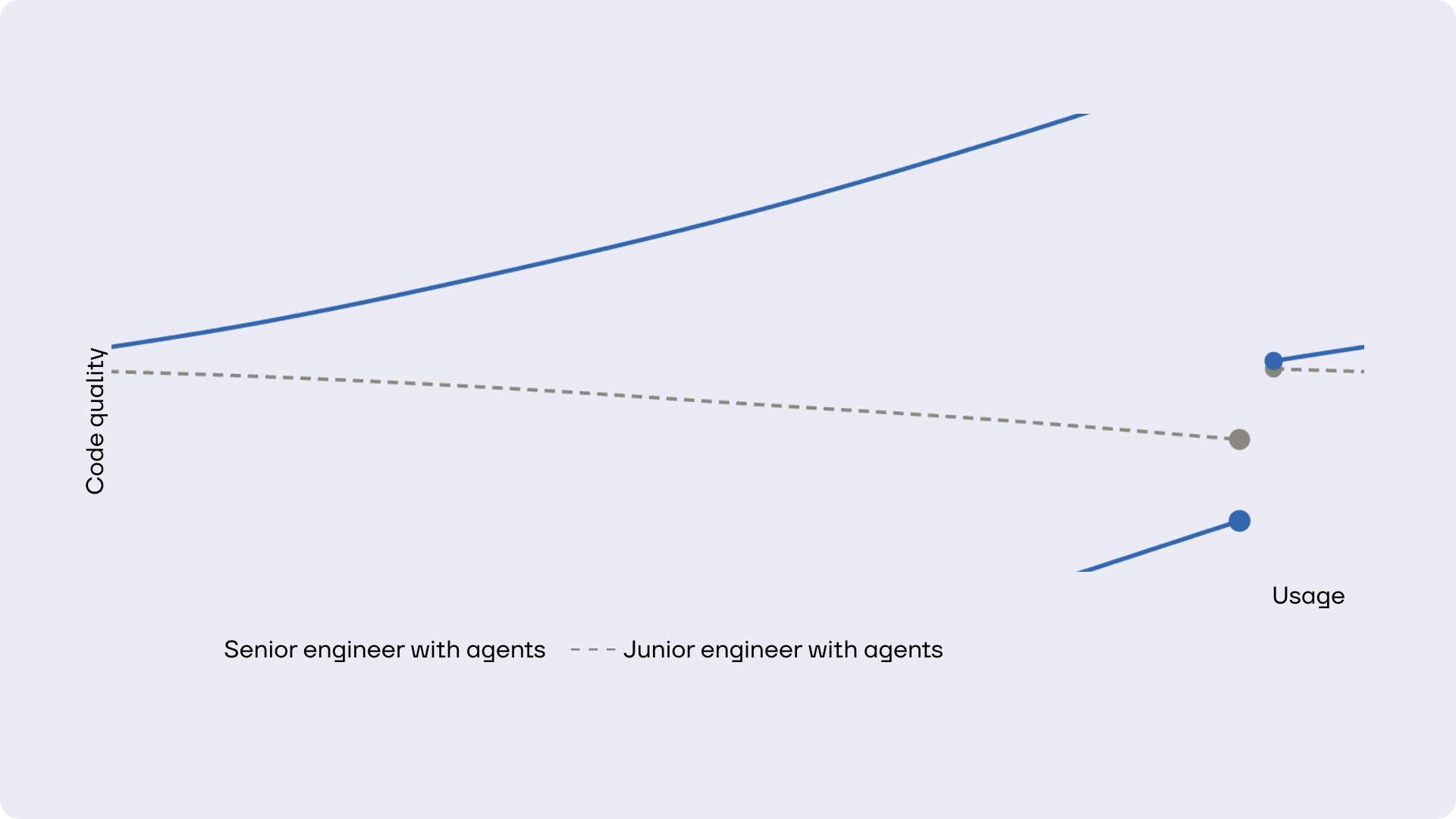
Seniority matters more, not less. A strong senior engineer with agentic tools becomes exponentially more productive. A weak engineer with the same tools produces weak code faster. The gap widens. It does not close.
What Leaders Get Wrong
The most common mistake: framing Agentic Coding as a cost-cutting measure. “We need fewer developers.” That logic is tempting in the short term and wrong in the medium term.
The right frame: the same developers ship more, faster, with less unnecessary overhead. That is the realistic ROI. And it is significant, if the rollout is taken seriously.
The second most common mistake: adopt the tool, leave the processes untouched. Agentic Coding changes how tasks need to be defined, handed off, and reviewed. Teams that ignore this are buying chaos wrapped in a productivity pitch.
My Position
Agentic Coding is not a hype cycle that will sort itself out. It is a structural shift in how software gets built, comparable to the introduction of version control or CI/CD pipelines. Those who ignore it now will catch up later, under worse conditions.
But it does not run itself. It requires clear ownership and processes, capable teams, and a genuine willingness to change how work gets done. Get that right, and the competitive advantage is real. Half-commit to it, and you have an expensive experiment.
The question is not whether. It is how well.